
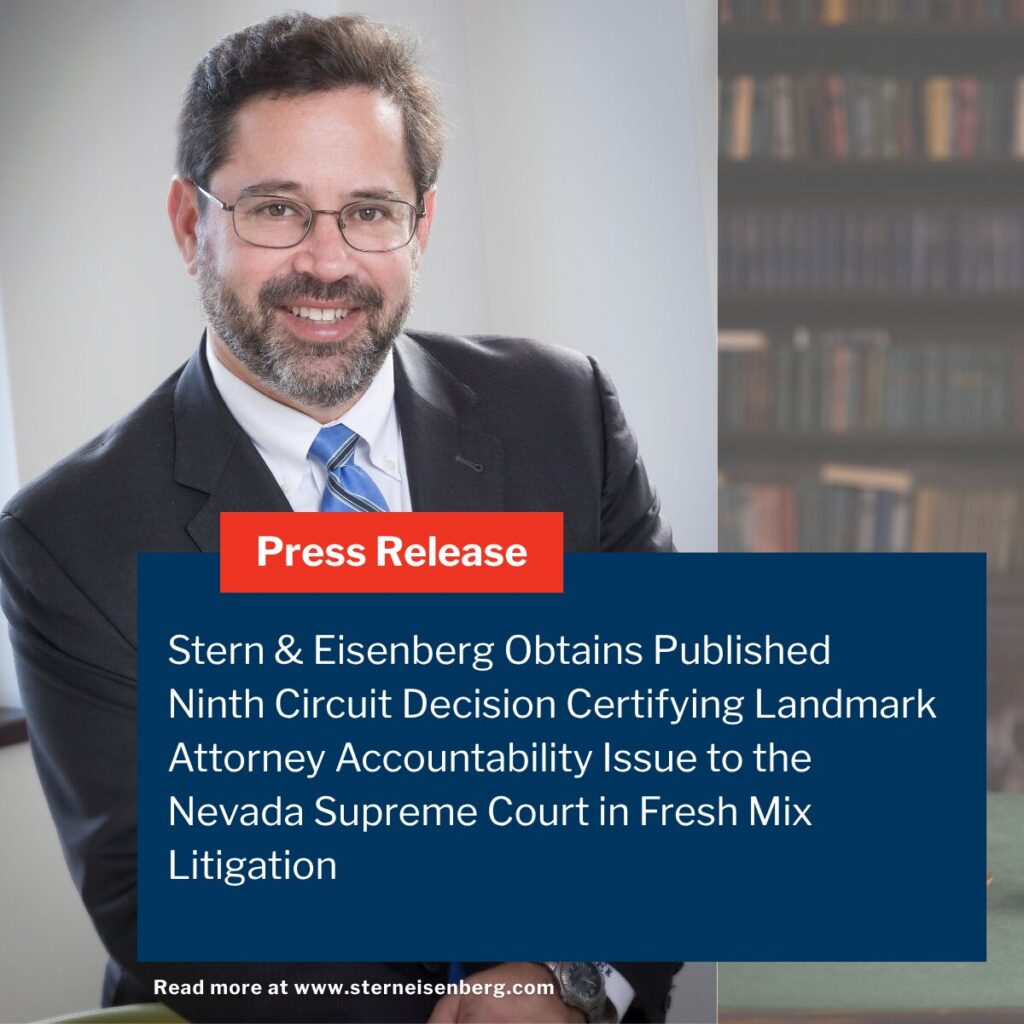
Ninth Circuit Recognizes Novel Questions at the Intersection of Attorney Loyalty, Corporate Governance, Legal Malpractice, and Nevada Public Policy
The Published Opinion can be reviewed HERE
Warrington, Pennsylvania
July 31, 2026
Stern & Eisenberg, P.C., today announced a significant appellate decision on behalf of its client, Fresh Mix, LLC, after the United States Court of Appeals for the Ninth Circuit issued a published opinion certifying a novel and consequential question of Nevada law to the Nevada Supreme Court.
The published decision marks an important development not only in the Fresh Mix litigation but also in Nevada jurisprudence governing attorney accountability, legal malpractice, corporate governance, and the rights of companies to seek redress for alleged serious misconduct by attorneys against the business when control of the company changes amongst owners.
Steven K. Eisenberg, Esquire, Founder, Managing Shareholder, and CEO of Stern & Eisenberg, argued the appeal before the Ninth Circuit on behalf of Fresh Mix. Following briefing and oral argument, the Court concluded that the appeal presents an unresolved question of exceptional importance that should be decided by Nevada’s highest court rather than by a federal court predicting state law.
The certified question asks:
Under what circumstances, if any, does a transfer of majority ownership in a corporate entity constitute a de facto assignment of that entity’s legal malpractice claims in violation of Nevada public policy?
Certification to a state’s highest court is reserved for issues that are both unsettled and likely to have broad significance beyond the immediate dispute. By certifying the issue, the Ninth Circuit recognized that the answer will have implications extending well beyond this litigation and may shape Nevada law for years to come.
Litigation Alleging Extraordinary Attorney Misconduct
The Ninth Circuit described the appeal as the latest chapter in years of complex litigation involving Fresh Mix.
As required at the pleading stage, the Court evaluated the case by accepting the complaint’s factual allegations as true for purposes of determining whether dismissal was appropriate. In doing so, the Court described allegations that Fresh Mix’s former attorneys acted in concert with the company’s then-controlling owner, placed that owner’s interests above those of the corporate client, breached duties of loyalty owed to Fresh Mix, and participated in a course of conduct culminating in an involuntary bankruptcy against Fresh Mix. The involuntary bankruptcy was ultimately dismissed by the Bankruptcy Court as having been initiated as an abuse of process.
Shortly before the abusive bankruptcy was dismissed, the feuding ownership groups resolved their differences with the minority owners, including the long time President and COO of Fresh Mix, having majority control of Fresh Mix. Upon dismissal of the abusive bankruptcy filing by the Bankruptcy Court and the claims against the attorneys revested from the bankruptcy estate back to Fresh Mix, Fresh Mix initiated a lawsuit against its former legal counsel for number of claims, including legal malpractice. The District Court, following the logic of a dissimilar fact pattern and conclusions of an unpublished Nevada Court of Appeals case, held that the change in ownership percentages amongst the existing owners constituted an improper assignment of the malpractice claim. The appeal to the Ninth Circuit followed. Following oral argument, the Ninth Circuit issued its opinion appearing to disagree with the District Court but understanding the impact under Nevada law may be significant.
The Ninth Circuit recognized that the appeal arises from allegations that go well beyond an ordinary legal-malpractice dispute. Instead, the allegations concern the fundamental duties lawyers owe to the clients they represent and the consequences that may follow when those duties are disregarded.
The Public Policy Question Before the Nevada Supreme Court
Nevada has long prohibited the outright assignment of legal-malpractice claims to a third-party as a matter of public policy. At the same time, Nevada recognizes the independent legal identity of corporations and limited liability companies, whose legal claims belong to the entity itself rather than to its individual owners. To complicate matters, at the time the ownership shifted from the majority over to the minority owners, the claims against the attorneys were under the exclusive control of the bankruptcy estate. The claims against the attorneys revested in Fresh Mix when the abusive bankruptcy was dismissed.
The Fresh Mix appeal presents the question of how those two well-established principles interact when ownership of a company changes amongst existing owners after the alleged wrongdoing occurred. The appeal implicates significant questions concerning the separate existence of the company along with the independent duty of loyalty attorneys owe to the company versus its members and managers who may have agendas clearly in conflict with the interests of the company.
The Ninth Circuit recognized that this legal issue as raised in the Fresh Mix case has never been answered by Nevada’s Supreme Court and that the answer carries substantial implications for Nevada’s public policy governing both attorney-client relationships and corporate law.
Attorney Accountability and the Integrity of the Profession
The Ninth Circuit’s decision is significant because it recognizes that the certified question is not merely technical or procedural. The issue implicates fundamental questions concerning attorney accountability.
If legal-malpractice claims belonging to a corporation could automatically disappear whenever ownership changes, significant attorney misconduct directed against a corporate client could become effectively insulated from judicial review. Such a holding would effectively override the separate nature of corporate existence, governance rules designed to protect minority ownership and allow attorneys to circumvent their duties and responsibilities to the business entity.
Fresh Mix has consistently maintained that Nevada law should not be interpreted to produce that result. The Ninth Circuit concluded that Nevada’s highest court should determine whether Nevada public policy permits such an outcome.
Should the Nevada Supreme Court accept the matter, the determination has the potential to become one of the leading Nevada decisions addressing the relationship between attorney loyalty, corporate separateness, and professional accountability.
Continuing Pursuit of Claims Against Defendant Law Firms
Stern & Eisenberg continues to prosecute Fresh Mix’s claims against the law firms and attorneys, who had provided legal advice and guidance to Fresh Mix and then who participated in the conduct in planning, implementing and perpetrating the abusive filing in the bankruptcy court as more described in the complaint and in pleadings filed in the underlying bankruptcy court case. A motion to reopen to pursue sanctions against those attorneys is currently pending before the bankruptcy court.
The claims raised in the complaint allege that attorneys entrusted with representing the corporate client, Fresh Mix, instead acted to advance interests adverse to that client by simultaneously providing legal advice in connection with the planning, implementation and perpetuation of the Fresh Mix involuntary bankruptcy proceeding. Before the Bankruptcy Court dismissed the involuntary it noted that one of its concerns was that the case was commenced “…to disadvantage the minority members and obtain an advantage in the state court action and arbitration”. The complaint alleges that Fresh Mix’s own counsel knowingly participated notwithstanding their legal and professional duties to their client.
The Ninth Circuit’s published opinion confirms that these allegations raise legal questions of statewide importance warranting review by Nevada’s highest court before the appeal proceeds further. The certification order recognizes that the legal consequences flowing from those allegations present issues of exceptional importance affecting the intersection of corporate and corporate governance jurisprudence together with professional legal duties and the future attorney-client relationships throughout Nevada.
Stern & Eisenberg’s Appellate Advocacy
The certification decision follows extensive briefing and oral argument presented by Steven K. Eisenberg on behalf of Fresh Mix.
Throughout the appeal, Stern & Eisenberg, on behalf of Fresh Mix, argued that the District Court should not have relied upon an unpublished Nevada Court of Appeals case which was not relevant to the Fresh Mix fact pattern. The Ninth Circuit seemingly agreed with Fresh Mix that there is no relevant controlling law concerning this novel and complex issue. A decision by the Nevada Supreme Court could have far-reaching consequences for legal-malpractice litigation, corporate governance, attorney ethics, and professional responsibility.
The Ninth Circuit agreed that authoritative guidance from Nevada’s highest court is desired before the appeal can be resolved.
Statement from Steven K. Eisenberg
“This is an important decision for our client and for the development of Nevada law,” said Steven K. Eisenberg. “The Ninth Circuit recognized that this case presents novel and consequential questions concerning attorney loyalty, professional accountability, and the ability of an injured corporate client to seek relief after control of the company changes amongst long-time business partners.”
He added: “Our firm remains committed to pursuing accountability for the conduct alleged in the complaint. We believe the forthcoming decision will have a meaningful impact on attorney ethics, corporate governance, and legal-malpractice litigation for years to come.”
About Stern & Eisenberg
Stern & Eisenberg is a nationally recognized litigation and appellate law firm representing clients in complex commercial disputes, bankruptcy litigation, business torts, creditors’ rights, intellectual property litigation, professional-liability matters, and appeals throughout the United States.